
Making pub explainers before publication: an agile approach to speed, risk, and review readiness
Publication explainer materials help field medical teams quickly understand and discuss new data after a manuscript is published. When a paper goes live, teams often need more than the article itself. They need a clear, structured, visually accessible summary of the study design, key results, clinical context, limitations, and potential questions that may come up in scientific exchange.
For many Medical Affairs teams, speed matters. In some organizations, publication support materials are expected to be available to field teams within 24 hours of a manuscript appearing online. That creates a practical challenge: if development only starts once the manuscript is published, there may not be enough time to concept, write, design, review, approve, and distribute the material.
One way to solve this is to begin development before publication. But doing so introduces risk. Manuscripts can change substantially during peer review. Data may be cut, revised, reframed, or replaced. Figures may change. Limitations may be expanded. Conclusions may be softened. Even after acceptance, editorial corrections or final publication formatting can still affect how data should be presented.
An agile approach can help balance speed with risk.
A practical example: an OLE publication explainer
In one recent project, a client requested a publication explainer for an open-label extension study before the manuscript had even been submitted. Their internal requirement was clear: publication support materials needed to be available to field teams within 24 hours of the manuscript being published online.
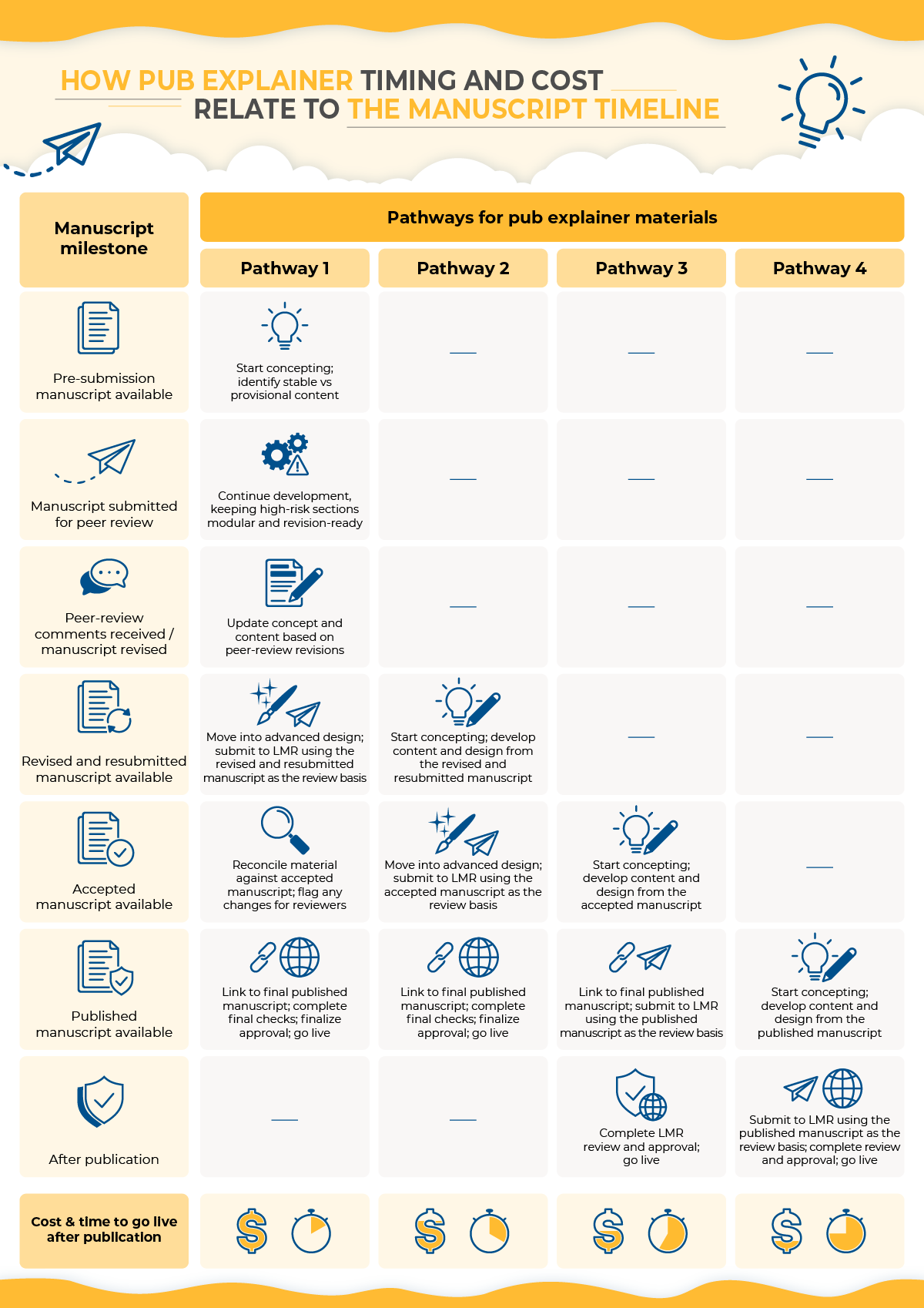
Waiting until publication was therefore not realistic. At the same time, the manuscript had not yet gone through peer review, which meant there was still a meaningful chance that reviewers would request changes. The project therefore needed to move forward while avoiding unnecessary rework. We therefore used pathway 1 shown below.
Phase 1: Concepting from a pre-submission manuscript
The first step was to develop a concept based on the pre-submission manuscript. At this stage, the focus was not on polishing every slide or locking in every detail. Instead, the goal was to understand the likely structure of the final material and identify which elements of the manuscript were stable enough to build around.
For example, certain aspects of a manuscript are usually less likely to be removed entirely:
- The study rationale and overall objective
- The broad study design
- The patient population and treatment sequence
- The core endpoint structure
- The general narrative of why the OLE matters
Other elements are more vulnerable to change during peer review:
- Specific efficacy or safety interpretations
- Secondary or exploratory endpoints
- Subgroup analyses
- Post hoc analyses
- Highly detailed figure callouts
- Discussion points that depend on reviewer-sensitive wording
- Conclusions that may need to be softened or reframed
This distinction shaped the early concept. The team could confidently build a high-level story around the study design, rationale, and overall evidence context, while treating more detailed data slides as provisional.
When a section is likely to change, it should be designed in a way that makes it easy to revise, replace, or remove later. This may mean using placeholder layouts, keeping data visualizations flexible, or postponing time-intensive design treatments until the manuscript is more stable.
Phase 2: Updating after peer review
Once reviewer comments were received and the manuscript was revised, the publication explainer concept was updated accordingly.
This is where the value of the earlier risk assessment became clear. Because the first version had been built around relatively stable elements, the core structure did not need to be rebuilt from scratch. Instead, the team could focus on targeted updates: adjusting the scientific narrative, revising data points, removing or reworking sections that had changed, and making sure the material reflected the revised manuscript.
At this stage, it is important to resist the temptation to treat the material as final. Even after peer-review revisions, the manuscript may still change again during resubmission, acceptance, copyediting, or final publication. The goal is to advance the material as far as possible without overinvesting in details that remain uncertain.
Phase 3: Design after resubmission
Once the manuscript had been revised and resubmitted for acceptance, the material moved into a more advanced design phase.
This is often the point at which it becomes reasonable to invest more heavily in slide design, visual structure, and figure adaptation. The manuscript is not entirely final yet, but the risk of major structural changes is usually lower than it was before peer review.
Even so, some elements still need to be treated carefully. Editorial feedback may affect figure footnotes, terminology, author wording, data labels, or small corrections. For that reason, detailed figures and heavily referenced slides should still be built with revision-readiness in mind.
For example, rather than creating highly customized visuals that would be difficult to adjust, it may be better to use clean, flexible figure designs that can accommodate updated labels, corrected values, additional footnotes, or changes in the manuscript’s final wording. That also means preserving some empty space on slides in anticipation that wording can become longer.
Phase 4: Planning the LMR review pathway early
The last phase is most important. Early development only saves time if the review pathway supports it.
For publication explainers, the limiting factor is often not writing or design. It is how soon legal, medical, and regulatory review can begin.
Before beginning development, teams should clarify several questions:
- Can the pre-acceptance manuscript be uploaded to the reference library in Veeva for anchoring?
- Is the publications team comfortable with reviewers seeing the manuscript before acceptance?
- Can LMR review against an unpublished manuscript?
- If the manuscript cannot be uploaded, can review happen offline?
- If offline review is not acceptable, does LMR review need to wait until acceptance or publication?
These questions determine whether starting early will actually get the pub explainer in the hands of field teams earlier.
In the OLE example, the workflow was aligned with reviewers ahead of time. The material was reviewed in Veeva without direct links to the manuscript, while reviewers were provided with the pre-acceptance manuscript separately. After the e-publication became available, the deck was updated, linked to the final published manuscript, submitted for approval, and approved quickly.
That workflow worked because it had been agreed in advance. It should not be assumed as a default.
In many cases, the more practical approach may be to link the material to a pre-accepted manuscript, revise the explainer in response to LMR feedback, and then update the material again once the manuscript is accepted or published. Any changes made to reflect the accepted or published manuscript should be clearly flagged for reviewers, and the final material should be linked to the final published article where required.
This approach has one drawback: it may result in multiple manuscript versions entering the reference library. That can be managed, but only if the process is deliberate. Unpublished manuscript versions should be clearly titled in the library to include their status and date, for example “Manuscript draft submitted for peer review Oct. 2026” or “Revised manuscript after peer review, Nov. 2026.” Once the article is published, any future materials should link to the published manuscript, not earlier drafts.
The cost-speed trade-off
Starting early can reduce the time between publication and field-team availability. But it usually increases the total amount of work.
A publication explainer developed entirely after publication will usually require less total working time. The source is final, the reference is available, and there is no need to chase manuscript revisions.
By contrast, a publication explainer developed in parallel with manuscript submission and peer review requires the team to “catch up” each time the manuscript changes. This may involve revising the concept, updating slides, replacing figures, adjusting claims, re-anchoring references, and resubmitting for review. Depending on the extent of manuscript changes, this can meaningfully increase cost — sometimes by 20–30%.
That additional investment can be worth it if the organization truly needs the material available immediately after publication and if the review pathway supports early review. But if LMR review cannot begin until the manuscript is accepted or published, much of the time saved during concepting and design may not translate into earlier availability.
In that situation, the best time-saved-to-cost ratio may be to start after the manuscript has been revised in response to peer review and resubmitted for acceptance. This avoids at least one potentially significant revision round while still allowing the material to be prepared before publication.
What an agile publication explainer workflow looks like
An effective workflow is not simply a faster version of the standard process. And there is no one-size-fits all solution. Getting the desired results means adapting the workflow to fit your organization’s needs.